Every second, your body runs thousands of chemical reactions. Almost none of them would happen fast enough on their own. Enzymes make them happen.
An enzyme is a protein that speeds up a chemical reaction without getting used up. When the reaction is done, the enzyme lets go of the product and is ready for the next molecule.
A pocket with a purpose
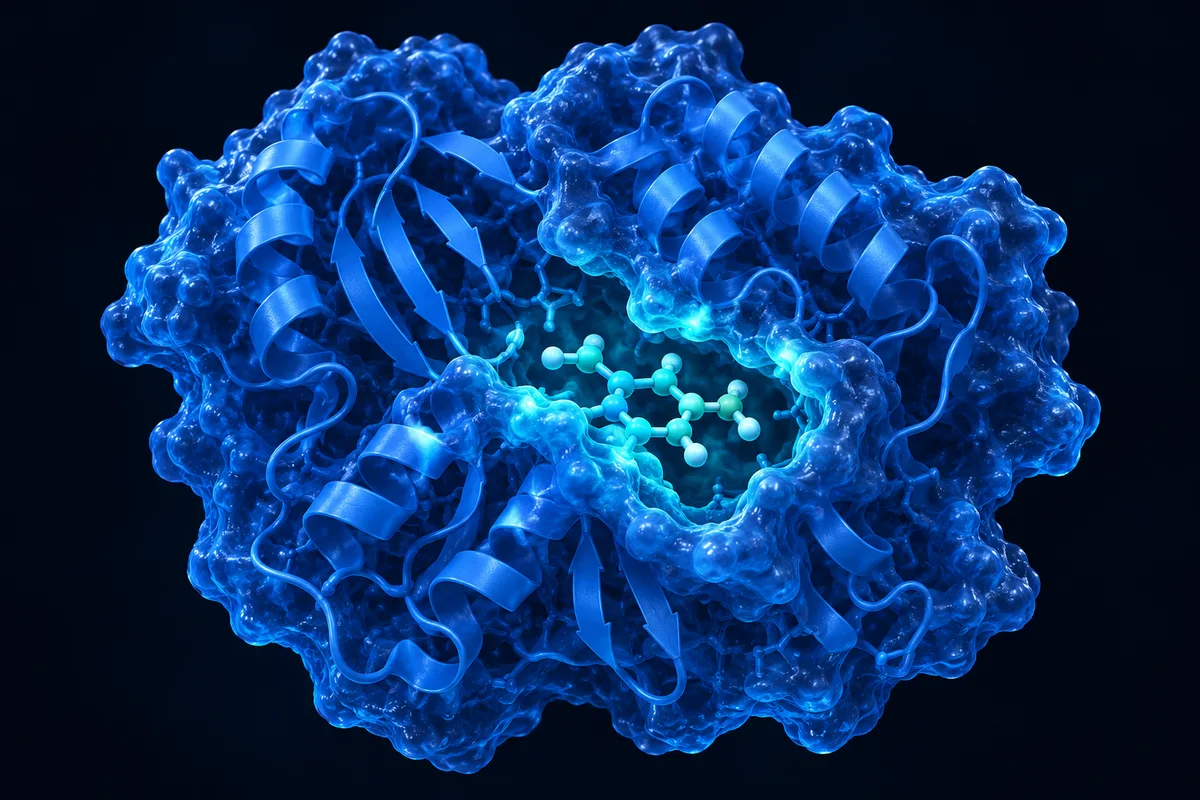
Like every protein, an enzyme is a chain of amino acids folded into one exact shape. Somewhere in that shape is a small pocket called the active site.
The active site fits the starting molecule the way a glove fits a hand. Once the molecule is inside, the amino acids lining the pocket hold it in exactly the right position. They push and pull electrons, bend bonds and line up the next step, until the reaction runs downhill.
The rest of the protein holds the pocket in shape.
How fast is fast?
Some reactions are slow without help. One famous example is a step in building DNA's raw materials. Left alone in water, half the molecules would take an estimated 78 million years to react. The enzyme that runs this step in your cells does it in a few milliseconds.
Most enzymes aren't that extreme, but speedups of a million times or more are normal.
You already use them
Enzymes aren't only inside cells.
- Laundry detergents use enzymes that break down protein and starch stains, which is why they work in cool water.
- Lactase tablets help people digest the sugar in milk.
- Cheese, bread and beer all depend on enzymes.
Industry likes enzymes because they work in water, at mild temperatures, and do one job very precisely.
The reaction nature never needed
Enzymes evolved over billions of years for the chemistry life needed. PFAS, the "forever chemicals", have only been made since the 1940s.
PFAS molecules are chains of carbon atoms covered in fluorine. The carbon-fluorine bond is one of the strongest bonds in organic chemistry. That strength is why PFAS are useful in non-stick pans and firefighting foam, and why they don't break down in the environment.
Nature does have a few enzymes that break a single carbon-fluorine bond in simple natural molecules. But a PFAS chain has many fluorines in a row, and evolution hasn't had time to come up with an enzyme that takes them apart well.
Designing backward
That's what we work on. Instead of searching nature for an enzyme that doesn't exist, we start from the reaction: which bond has to break, and what the pocket around it needs to look like. Then we design backward to a protein shape, and from the shape to a sequence of amino acids.
It's the same idea Pip keeps coming back to. Change the order, change the shape, change the job. Next week Pip takes on the forever chemicals themselves.